
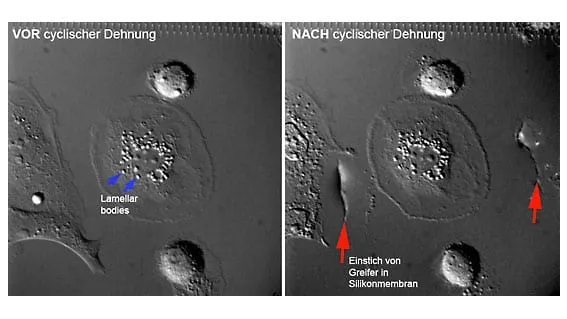
Mechanobiology
Apply precise, calibrated forces to cells and tissue, and read out how they respond.
How a cell senses force is one of biology’s hardest things to measure: you have to apply a known, repeatable mechanical stimulus to something a few micrometres across while recording its response in real time.
A Nanomotor® manipulator makes that practical. It can ramp a glass probe into a membrane in sub-micron steps at a controlled velocity to evoke mechanically activated currents, carry a microgripper to stretch a cell on an elastic membrane, or hold an FMS-LS force sensor to apply and read a defined force. The work behind the 2021 Nobel-recognized touch field leaned on exactly this kind of controlled poke.
Articles & videos
Short, focused reads and in-microscope footage — start with the introduction or jump to a technique.
Technical deep-dives
Evoking mechanically activated currents
The 'poke' assay: indenting a patch-clamped cell to open mechanically gated channels.
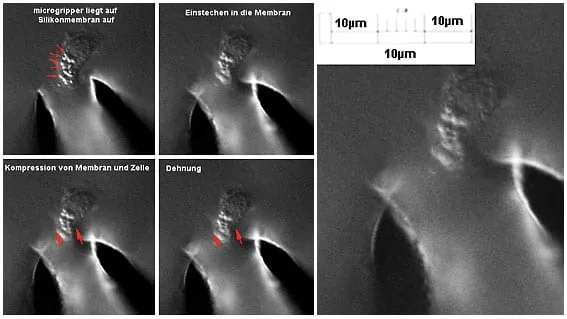
Stretching cells and tissue
Applying stretch and defined force to cells on elastic substrates and to soft tissue.
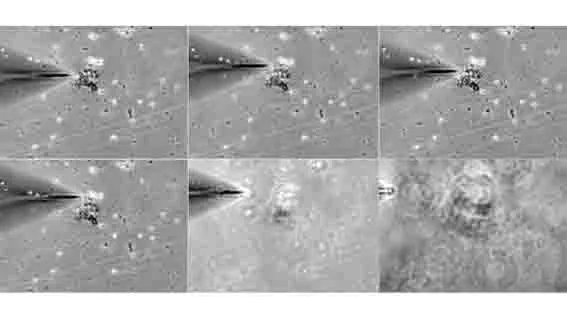
Microdissection
Cutting structures as fine as chromosomes with a sharp glass needle.
Products used
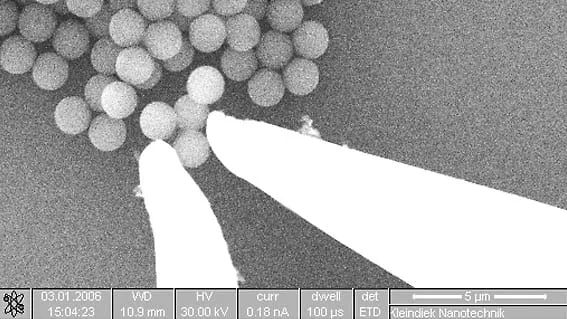
Micro Gripper MGS2
A two-jaw micro-gripper that picks up, holds and repositions micro-objects inside the electron microscope.
View product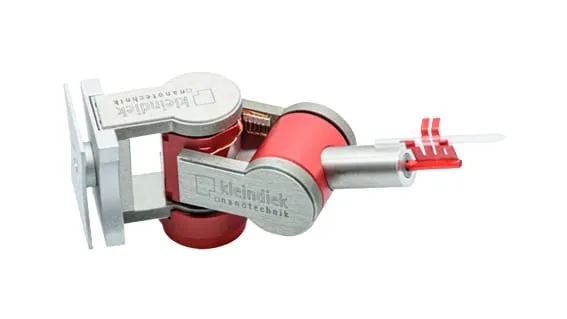
MM3A-LS
The MM3A micromanipulator configured for highly sensitive electrophysiology — long-term stability and sub-nanometre precision.
View product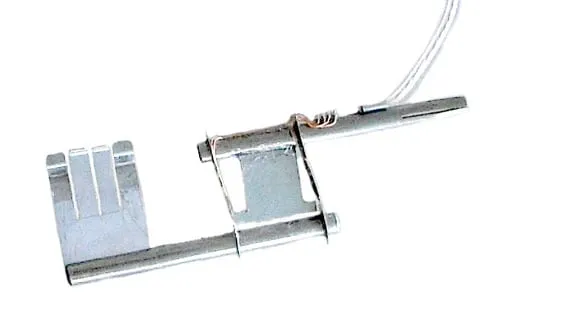
FMS-LS
A force transducer for life science — apply and record known forces (e.g. to skin samples) alongside patch-clamp recordings.
View productRelated publications
A stomatin-domain protein essential for touch sensation in the mouse
DOI 10.1038/nature05394Mechanosensitive currents in the neurites of cultured mouse sensory neurones
DOI 10.1113/jphysiol.2006.117648A T-type calcium channel required for normal function of a mammalian mechanoreceptor
DOI 10.1038/nn1076Talk to an application engineer
Tell us your sample and your microscope — we’ll walk you through the workflow and route you to the right regional team.